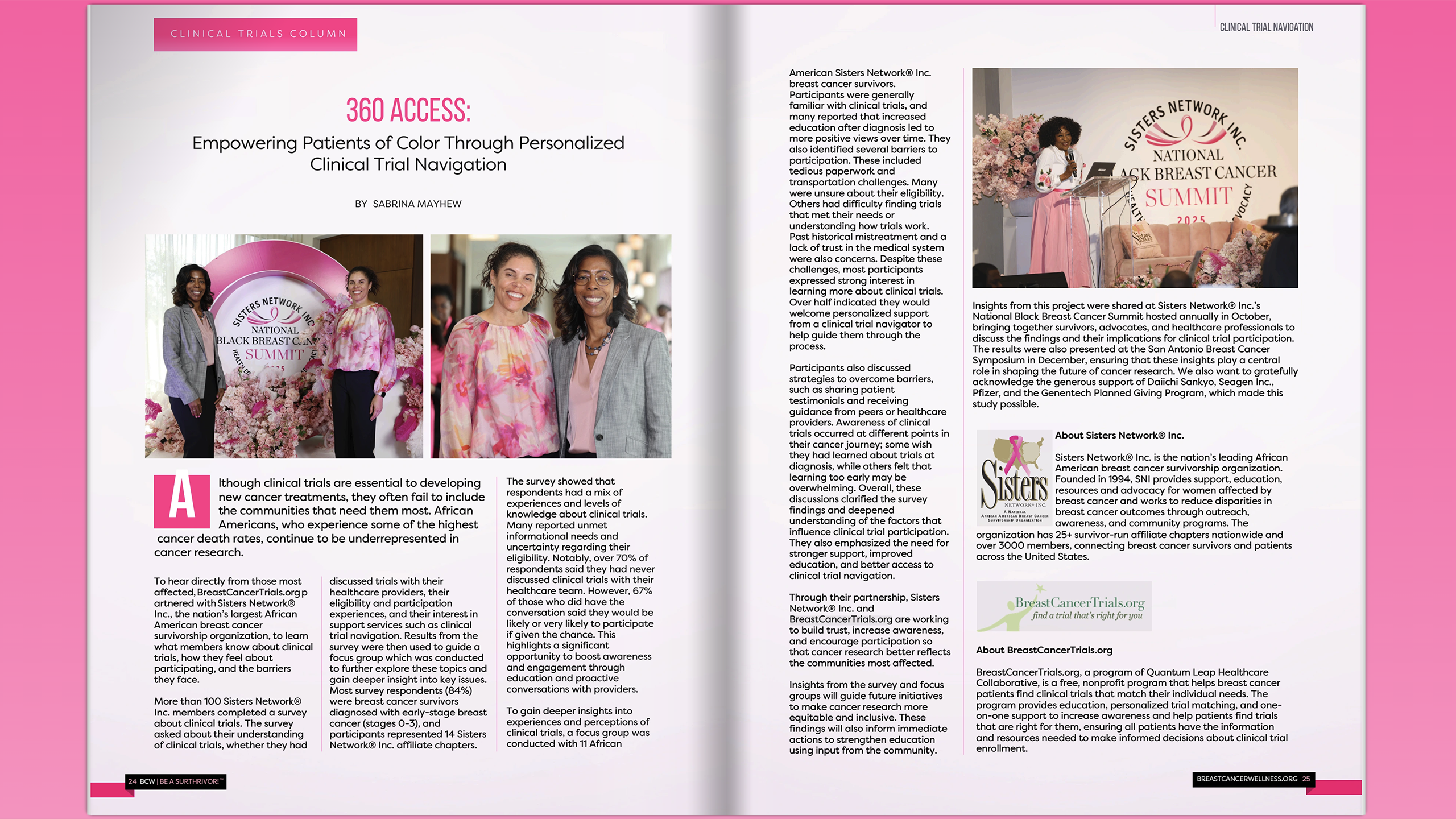


BY SABRINA MAYHEW
Although clinical trials are essential to developing new cancer treatments, they often fail to include the communities that need them most. African Americans, who experience some of the highest cancer death rates, continue to be underrepresented in cancer research.
To hear directly from those most affected, BreastCancerTrials.org partnered with Sisters Network® Inc., the nation’s largest African American breast cancer survivorship organization, to learn what members know about clinical trials, how they feel about participating, and the barriers they face.
More than 100 Sisters Network® Inc. members completed a survey about clinical trials. The survey asked about their understanding of clinical trials, whether they had discussed trials with their healthcare providers, their eligibility and participation experiences, and their interest in support services such as clinical trial navigation. Results from the survey were then used to guide a focus group which was conducted to further explore these topics and gain deeper insight into key issues. Most survey respondents (84%) were breast cancer survivors diagnosed with early-stage breast cancer (stages 0-3), and participants represented 14 Sisters Network® Inc. affiliate chapters.
The survey showed that respondents had a mix of experiences and levels of knowledge about clinical trials. Many reported unmet informational needs and uncertainty regarding their eligibility. Notably, over 70% of respondents said they had never discussed clinical trials with their healthcare team. However, 67% of those who did have the conversation said they would be likely or very likely to participate if given the chance. This highlights a significant opportunity to boost awareness and engagement through education and proactive conversations with providers.
To gain deeper insights into experiences and perceptions of clinical trials, a focus group was conducted with 11 African American Sisters Network® Inc. breast cancer survivors. Participants were generally familiar with clinical trials, and many reported that increased education after diagnosis led to more positive views over time. They also identified several barriers to participation. These included tedious paperwork and transportation challenges. Many were unsure about their eligibility. Others had difficulty finding trials that met their needs or understanding how trials work. Past historical mistreatment and a lack of trust in the medical system were also concerns. Despite these challenges, most participants expressed strong interest in learning more about clinical trials. Over half indicated they would welcome personalized support from a clinical trial navigator to help guide them through the process.
Participants also discussed strategies to overcome barriers, such as sharing patient testimonials and receiving guidance from peers or healthcare providers. Awareness of clinical trials occurred at different points in their cancer journey; some wish they had learned about trials at diagnosis, while others felt that learning too early may be overwhelming. Overall, these discussions clarified the survey findings and deepened understanding of the factors that influence clinical trial participation. They also emphasized the need for stronger support, improved education, and better access to clinical trial navigation.
Through their partnership, Sisters Network® Inc. and BreastCancerTrials.org are working to build trust, increase awareness, and encourage participation so that cancer research better reflects the communities most affected. Insights from the survey and focus groups will guide future initiatives to make cancer research more equitable and inclusive. These findings will also inform immediate actions to strengthen education using input from the community.
Insights from this project were shared at Sisters Network® Inc.’s National Black Breast Cancer Summit hosted annually in October, bringing together survivors, advocates, and healthcare professionals to discuss the findings and their implications for clinical trial participation. The results were also presented at the San Antonio Breast Cancer Symposium in December, ensuring that these insights play a central role in shaping the future of cancer research. We also want to gratefully acknowledge the generous support of Daiichi Sankyo, Seagen Inc., Pfizer, and the Genentech Planned Giving Program, which made this study possible.
Sisters Network® Inc. is the nation’s leading African American breast cancer survivorship organization. Founded in 1994, SNI provides support, education, resources and advocacy for women affected by breast cancer and works to reduce disparities in breast cancer outcomes through outreach, awareness, and community programs. The organization has 25+ survivor-run affiliate chapters nationwide and over 3,000 members, connecting breast cancer survivors and patients across the United States.
BreastCancerTrials.org, a program of Quantum Leap Healthcare Collaborative, is a free, nonprofit program that helps breast cancer patients find clinical trials that match their individual needs. The program provides education, personalized trial matching, and one-on-one support to increase awareness and help patients find trials that are right for them, ensuring all patients have the information and resources needed to make informed decisions about clinical trial enrollment.