
Lorem ipsum dolor sit amet, consectetuer adipiscing elit, sed diam nonummy nibh euismod tincidunt ut laoreet dolore magna aliquam erat volutpat. Ut wisi enim ad minim veniam, quis nostrud exerci tation ullamcorper suscipit lobortis nisl ut aliquip ex ea commodo consequat. Duis autem vel eum iriure dolor in hendrerit in vulpu
Lorem ipsum dolor sit amet, consectetuer adipiscing elit, sed diam nonummy nibh euismod tincidunt ut laoreet dolore magna aliquam erat volutpat. Ut wisi enim ad minim veniam, quis nostrud exerci tation ullamcorper suscipit lobortis nisl ut aliquip ex ea commodo consequat. Duis autem vel eum iriure dolor in hendrerit in vulpu
Lorem ipsum dolor sit amet, consectetuer adipiscing elit, sed diam nonummy nibh euismod tincidunt ut laoreet dolore magna aliquam erat volutpat. Ut wisi enim ad minim veniam, quis nostrud exerci tation ullamcorper suscipit lobortis nisl ut aliquip ex ea commodo consequat. Duis autem vel eum iriure dolor in hendrerit in vulpu
Lorem ipsum dolor sit amet, consectetuer adipiscing elit, sed diam nonummy nibh euismod tincidunt ut laoreet dolore magna aliquam erat volutpat. Ut wisi enim ad minim veniam, quis nostrud exerci tation ullamcorper suscipit lobortis nisl ut aliquip ex ea commodo consequat. Duis autem vel eum iriure dolor in hendrerit in vulpu
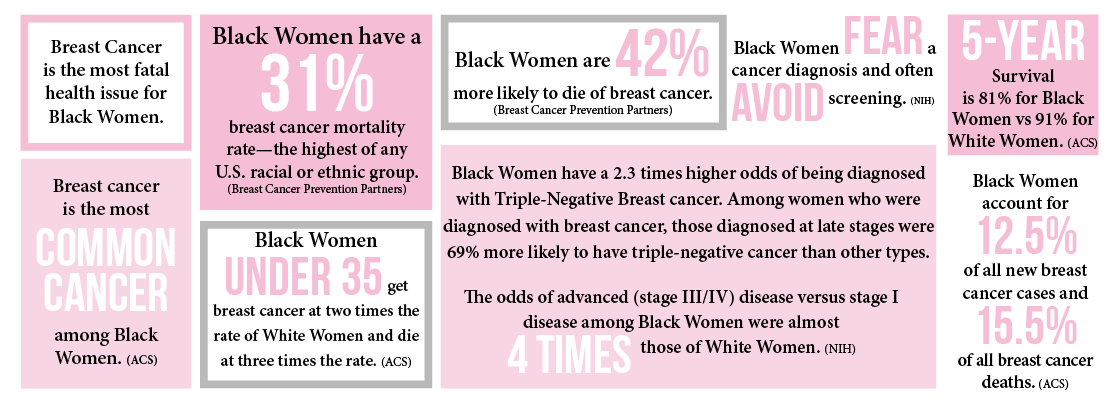
Breast cancer is the most commonly diagnosed cancer among black women, and an estimated 33,840 new cases are expected to be diagnosed in 2019. An estimated 6,540 deaths from breast cancer are expected to occur among black women in 2019.
Though Black women get breast cancer at a slightly lower incidence rate (3%) than white women, Black women are 42% more like to DIE of breast cancer than white women. That is an astounding number and indicative of a variety of factors, many reflecting racial disparities.
Women do not need to DIE from breast cancer. It can’t be prevented but early stage breast cancer (meaning it has been localized within the breast) has a 99% 5 year survival rate.
Note the inequity here: the overall 5-year relative survival rate for breast cancer diagnosed is 80% for black women versus 91% for white women. And, 52% of breast cancers in black women are diagnosed at a local stage, compared to 63% in white women.
To add more fuel to the fire, Black women under age 40 have higher rates of breast cancer when compared to white women. Black women under age 35 get breast cancer at two times the rate of white women and DIE from breast cancer three times as often as white women.
The overall 5-year relative survival rate for breast cancers diagnosed in 2008-2014 was 81% for black women compared to 91% for white women. This difference can be attributed to both more advanced stage at detection and poorer stage-specific survival among black women. Only 54% of breast cancers in black women are diagnosed at a local stage, compared to 64% in white women.

To amplify awareness and education that there is breast cancer crisis in the Black community.
Provide the support and sisterhood through our extensive 25+ survivor-run affiliate chapters in major U.S. cities.
Mobilize and provide advocacy training to our affiliate network of survivors and ambassadors to take action and advocate for change on the state and federal level to help save our Sisters’ lives.
To improve black women’s access to mammogram screenings, quality care and access to resources and information.
In the most recent period (2006-2015), incidence rates increased slightly more rapidly in NH black women (0.9% per year) than in NH white women (0.4% per year), contributing to a convergence in incidence rates.
During 2011-2015, the overall breast cancer incidence rate in NH black women was 126.5 cases per 100,000 women compared to 130.1 in NH white women. However, rates were higher in NH black women than NH white women in eight US states (Alabama, Indiana, Louisiana, Michigan, Mississippi, Missouri, North Carolina, and Virginia), and were not significantly different in 20 other states. Breast cancer incidence rates are also higher among blacks than whites for women under age 45. The median age of diagnosis is 59 for black women, compared to 63 for white women.


Black women are twice as likely as women of other racial and ethnic groups in the US to be diagnosed with triple negative breast cancers, so called because they lack estrogen receptors, progesterone receptors, and human epidermal growth factor receptor-2. Women with these tumors generally have poorer outcomes because effective treatments have not been developed. A recent analysis comparing molecular features of breast cancers in black and white women estimated that 40% of the racial variation in breast cancer subtype are due to inherited genetic mutations. Inflammatory breast cancer, a rare but aggressive subtype, is also more common in black women than white women.


For media inquiries or general assistance, please email infonet@sistersnetworkinc.org.
Contact UsPlease feel free to download our general brochures to use to learn share information about Sisters Network Inc., find a SNI affiliate chapter in your city, Key National Programs, learn more about early detection, breast cancer facts and figures for Black women, what to ask your doctor and much more.
For more information about breast cancer subtypes, see Breast Cancer Facts & Figures at cancer.org/statistics.